Urban infrastructure has long-lasting consequences on public health — and civil engineer Suha Atiyeh has centered this reality throughout her career. She approaches each project as a long-term health intervention, not just a transportation or drainage assignment. Her licensure across Washington DC, Virginia, and the UK supports a multiregional perspective that strengthens her holistic design philosophy.
Her Washington DC portfolio illustrates this clearly. The Wheeler Road stormwater improvements reduced flooding stress for residents — which directly decreases mold risk, mobility hazard, and outdoor quality deterioration. MLK Jr. Avenue upgrades enhanced pedestrian connectivity while green infrastructure reduced heat concentrations — translating to improved outdoor usability and mental wellness. At St. Elizabeths and Kenilworth Courts, permeable pavements and bioswales improved runoff infiltration while also activating outdoor civic space — an environmental benefit and a social health benefit.
Her international work reinforces the public health dimension of infrastructure. In the UAE, Suha contributed to Masdar City, where water efficiency systems and renewable energy deliver large-scale environmental performance. She also led water quality assessment work and stormwater mitigation studies — supporting resilience in an arid region where water scarcity intensifies population vulnerability.
Her sustainability design certifications — LEED AP, Envision, and Estidama Pearl — reflect her ongoing commitment to health-focused engineering practice rather than siloed climate metrics alone.
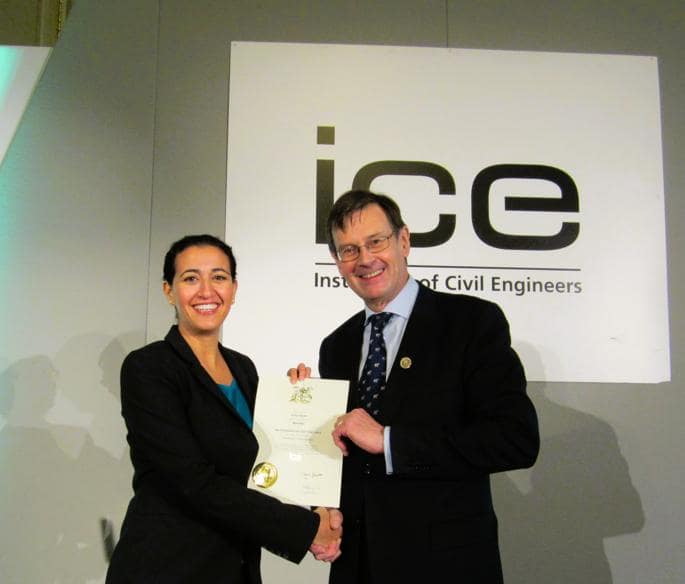
As ICE Representative for the US Mid-Atlantic South Region, she continues to elevate the role engineers play in shaping long-term community wellbeing. She advocates for future engineers to design with the understanding that infrastructure is public health infrastructure — not simply physical infrastructure.